




Amid rising global interest in sustainability-focused management, impact investing that seeks both financial returns and social impact is drawing growing attention. Africa, often called the “last growth market,” offers strong potential for investments in businesses tackling severe challenges such as poverty and limited access to finance.
In Kenya, the widespread adoption of ride-hailing apps has made taxi driving a major source of employment for the young generation and an important pillar supporting the country’s transport infrastructure. Yet many drivers cannot gain access to credit from existing financial institutions to buy their own vehicles, leaving them with no choice but keep paying vehicle rental fees, missing out on opportunities to build equity over time. To tackle this issue, HAKKI GROUP Inc. (HAKKI) has developed its own credit-scoring model that provides business auto loans without high risk exposure.
Recognizing the potential of this model, SMBC Venture Capital Co., Ltd. (SMBCVC) made its first investment in HAKKI in 2023. In addition to that, after SMBC Group established its impact investing framework in 2024, SMBCVC further executed SMBC Group’s first impact investment in HAKKI in 2025.
Visualize and Communicate Impact to Unlock
New Growth Opportunities
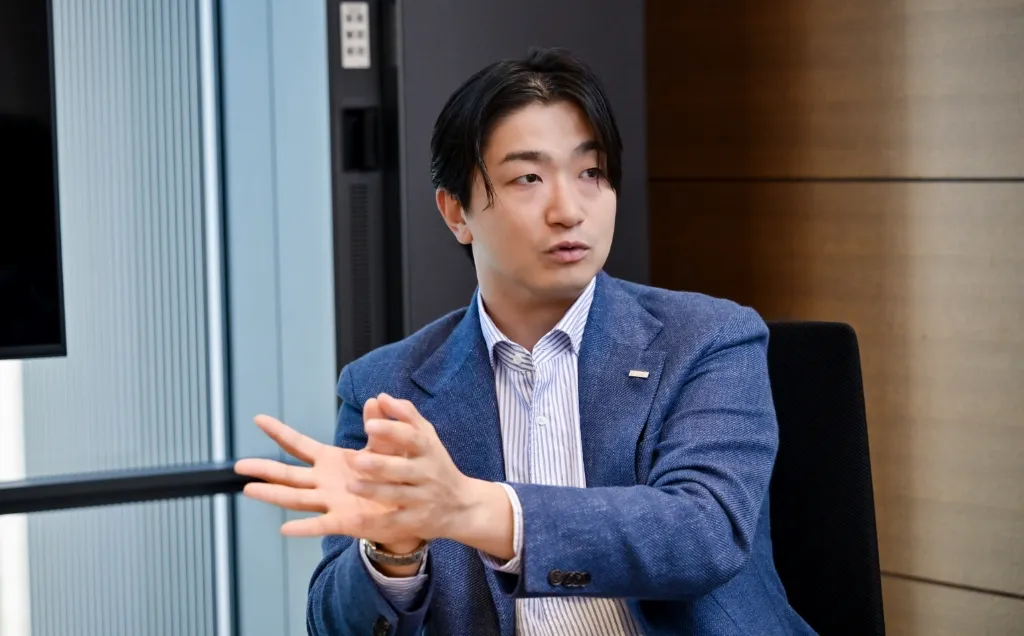
Hideaki Imaeda of SMBCVC’s Investment Dept. I, who led the impact investment in HAKKI, former investment banker of Structured Finance Dept. at Sumitomo Mitsui Banking Corp., aspires to “enrich people’s lives through financing infrastructure development.” His aspiration resonated with HAKKI’s business and became a driving force behind his commitment.
In parallel with analyzing HAKKI’s profitability, Imaeda was deeply involved in visualizing its impact. He worked closely with HAKKI’s management to co-create a logic model and Key Performance Indicators (KPIs) that visualize the business’s impact.
HAKKI, however, did not initially intend to emphasize its impact. Head of Group Corporate Planning Dept. at HAKKI, Yumeka Abe, described their position at the time:
“Initially, we did not see ourselves as a social startup. We believe that any business can achieve sustainable growth only by contributing to the society. Based on this belief, we thought that if we steadily grow our business, investment would naturally follow without us having to deliberately highlight our impact.”
This perspective shifted, however, through their dialogue with SMBCVC. Creating the logic model, in particular, became a major trigger for recognizing the importance of objectively organizing, articulating, and communicating their initiatives. Through this process, HAKKI published its first impact report in July 2025. Abe noted that this step was driven by a clear purpose linked to future growth:

“As we look toward an IPO in Japan, we believe it is necessary, as part of our marketing and investor relations activities, to communicate both our steady business growth and our social impact.”
Academically Verifying the Causal Relationships of Impact:
Advancing Impact Measurement Through
University Collaboration
While HAKKI was working to visualize and communicate its impact, Moeri Yatsu of Sumitomo Mitsui Financial Group, Inc.’s Sustainability Development Dept. recognized the need to establish a framework to enhance the objectivity of impact measurement. Believing that collaboration with academia was essential to address this challenge, she initiated a partnership with the Graduate School of Economics at the University of Tokyo. Through this collaboration, the team established a framework to objectively demonstrate the impact of businesses on society and the environment.
Through this partnership, the team incorporated an economic perspective, and is also working with Teruyo Ishijima, a project researcher at the Graduate School of Education at the University of Tokyo, to measure whether taxi drivers’ self-efficacy is improving. Ishijima explained the respective roles of economics and education in this collaboration, and its significance:

“The significance of this collaboration lies in combining the verification of profitability from an economic perspective, ‘Is it a viable business?’, with the verification of social value from an educational perspective, ‘What internal changes and growth does the business bring to people?’ We believe that having these two wheels allows us to capture a more objective, overall picture of the impact a business generates.”
In this measurement, Ishijima employed a content analysis using a “discourse code map” to visualize the relationships between words spoken in interviews. Her analysis revealed a structure in which establishing an economic foundation and supporting business continuity lead to an increase in self-efficacy.
Specifically, HAKKI’s auto loans enable drivers to break free from the cycle of paying ongoing rental fees and open a path toward future asset formation. In addition, HAKKI’s support department works closely with drivers, providing hands-on assistance to help them overcome challenges they cannot address on their own. This combination of establishing an economic foundation and providing support for business continuity nurtures a sense of self-efficacy, a belief that “I can do it,” and a sense that their options in life are expanding.
Creating Greater Impact from the Perspectives of Startups,
Finance and Academia
Looking ahead, HAKKI plans to expand into other Global South countries, beginning with business expansion into South Africa and India in 2025. Abe views HAKKI’s role from a broader perspective:
“Our role is to be a bridge connecting Japan and emerging countries. To support our local customers, who are the main characters of the story, we want to serve as coordinators who build mutually beneficial business models by designing services that are needed locally, rather than unilaterally imposing a Japan-centric perspective.”
Building on the insights gained through this research, the University of Tokyo and SMBC Group will build on the knowledge gained from this research to launch a Corporate Sponsored Research Program titled the Corporate Value Design 2030 and begin joint research in April 2026. The course will focus on the theme of “the mechanism by which social value contributes to mid-long-term economic value.” As part of the research agenda, it will build an evidence base and methods. In addition, the course will offer lectures for students and working professionals on designing business concepts that generate economic value by creating social value, as well as on the institutional and policy frameworks needed to bring such concepts and practice. Ultimately, the course is intended to serve as a forum that sparks new questions for business and society. Yatsu envisions a broader societal transformation beyond this initiative:

“We aim to embed the perspective of social value into corporate management, while substantiating that efforts to create social value can become a source of mid-long-term competitiveness and contribute to economic value. Ultimately, we hope to reach a world where the term ‘impact’ is no longer needed.”
The future Yatsu envisions will be shaped through collaboration among companies that take on social challenges and the partners. Imaeda, who plays a role as an investor, shared his thoughts on his position:
“I believe that solving social issues can only be achieved through the collaboration of many stakeholders, including startups. In this major chemical reaction, as one of financial professionals, I aspire to be a catalyst that enables and accelerates solutions to social challenges.”