Business Strategy

One distinctive feature of SMBC Group is that the roles of Group CFO and Group CSO are held by the same individual. Under the new Medium-Term Management Plan, as Group CFO, I will exercise rigorous control over both our balance sheet and capital allocation by strategically allocating capital, risk assets, expenses, and other management resources to achieve disciplined investment and detailed management. As Group CSO, I will take a bird’s-eye view of SMBC Group’s businesses and accelerate the execution of key strategies by leveraging our strong planning capabilities and exceptional speed of execution to transform our business portfolio.
Through the integrated management of our financial and business strategies, we will enhance ROTE/ROE and drive profit growth, thereby advancing SMBC Group toward its medium- to long-term Vision.
Overview of the Previous Medium-Term Management Plan
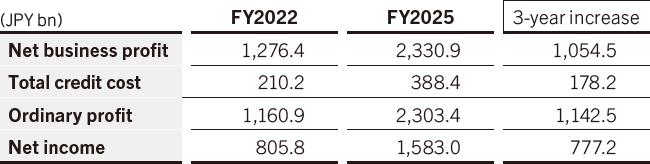
We entered FY2025 amid heightened economic uncertainty including U.S. tariff policy. However, the impact of these factors was less significant than initially anticipated. We achieved a substantial increase in profit from our domestic businesses by capturing opportunities arising from the Bank of Japan’s policy rate hikes and other favorable business conditions. In Japan, as the country exited the negative interest rate regime, we strengthened our customer base by leveraging Olive across deposits, payments, and wealth management. We also increased profit through higher revenue from loans and fees generated by active corporate activity. Overseas, we continued to replace low-margin assets with higher-margin assets while expanding our securities business through our partnership with Jefferies, further improving the quality of our portfolio.
While increasing earnings, we also strengthened our preparedness for potential downside risks. For example, we recorded additional forward-looking provisions in response to the Middle East situation and inflation risk. Even after taking these measures, we generated net income of ¥1.583 trillion and EPS of ¥412, both record highs. In addition, ROE exceeded 10%, enabling us to achieve the financial targets set under the previous Medium-Term Management Plan.
I believe we can confidently say that we brought the previous Plan to a strong and successful conclusion.
Medium-to Long-Term Vision and New Medium-Term Management Plan
Medium-to Long-Term Vision
Since the establishment of SMBC Group, we have overcome numerous challenges, including the Global Financial Crisis and the introduction of negative interest rates. Even in difficult times, we never stopped sowing the seeds for future growth. As a result, supported also by a favorable business environment, we have delivered record profit for three consecutive years.
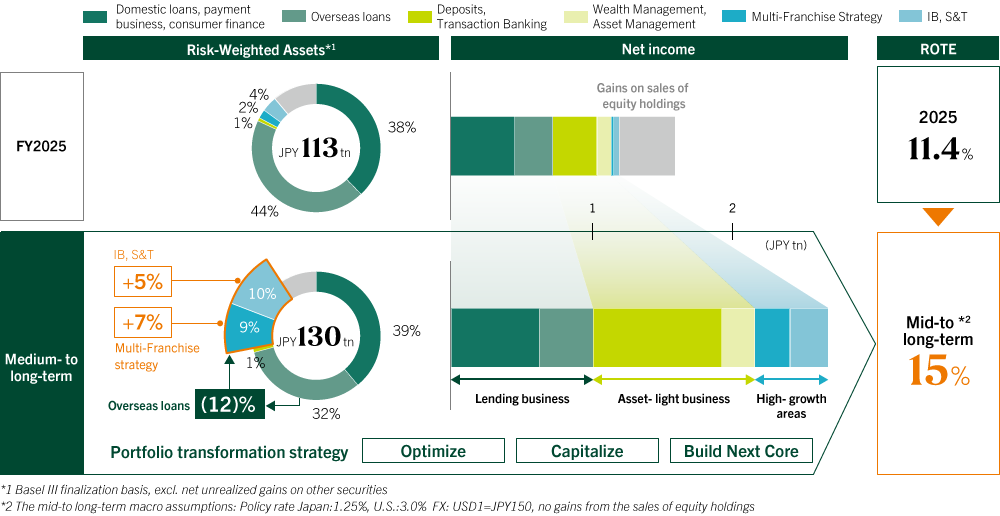
However, we are by no means satisfied with our progress. Looking ahead, we have set ambitious targets as we seek to achieve market leadership in our domestic businesses while further strengthening our global presence. We have established medium- to long-term goals of 15% ROTE and net income in the mid-¥2 trillion range as we strive to stand alongside leading global financial institutions.
To achieve ROTE of 15%, we must successfully transform our business portfolio. Our portfolio transformation is based on three key themes. The first is “Optimize,” under which we will optimize our business portfolio and enhance capital and expense efficiency. The second is “Capitalize,” under which we will fully harvest the benefits of past initiatives and capture upside opportunities. The third is “Build Next Core,” under which we will develop businesses that can become future growth pillars for SMBC Group. Specifically, we will reallocate risk assets from overseas loans and other low-margin businesses to the Multi-Franchise Strategy, investment banking, S&T, and other high-margin and growth areas. At the same time, we will strengthen our stable domestic lending business and asset-light businesses such as wealth management, asset management, and transaction banking. Through these efforts, we will transform our business portfolio in a way that balances profitability, growth and stability, thereby increasing the profitability of each business and achieving ROTE of 15%.
New Medium-Term Management Plan
Our base case scenario for our business environment is one in which opportunities continue to emerge amid solid economic conditions both in Japan and overseas. At the same time, I am also factoring in a number of stress scenarios. In Japan, these include intensified competition for deposits as interest rates rise and a slowdown in client business activity if Japan’s renewed growth momentum stalls. Overseas, rising geopolitical risk is another possible scenario. With regard to the situation in the Middle East, we recorded additional forward-looking provisions at the end of FY2025, which I believe will enable us to absorb a reasonable level of downside risk. Nevertheless, we will continue to closely monitor the potential impact of rising oil prices and supply chain constraints on corporate performance and manage our business flexibly.
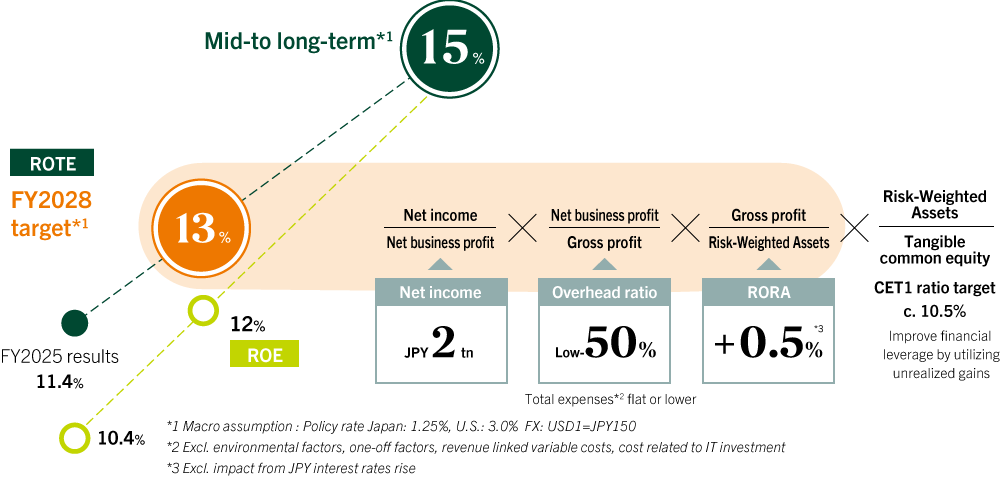
Against this backdrop, in the new Medium-Term Management Plan, we did not set targets solely through the traditional build-up approach. Instead, we backcasted from our medium- to long-term ROTE target of 15% to determine the level we should reach by the end of the new Plan. By controlling expenses and improving RORA, we aim to increase net income to ¥2 trillion and achieve ROTE of 13% by FY2028. Through disciplined expense and capital management, we will realize capital efficiency accompanied by revenue growth.
We have established seven key strategic areas in the new Medium-Term Management Plan. We will achieve leadership in the domestic market by using digital platforms such as Olive and Trunk to expand our deposit base and also to strengthen our corporate and wealth management businesses. Overseas, we will transform our business model by moving away from our traditional loan-focused model to a more capital efficient model with CIB and S&T as the pillars and by pushing forward the monetization of our Multi-Franchise Strategy. Furthermore, we will strengthen asset-light businesses such as transaction banking and asset management in and outside of Japan.
In addition to enhancing our customer base and earning power, we will generate synergies between our key strategic areas and evolve the respective business models.
Our net income target for FY2026, the first year of the new Plan, is ¥1.7 trillion.
Capital Policy
Basic Capital Policy
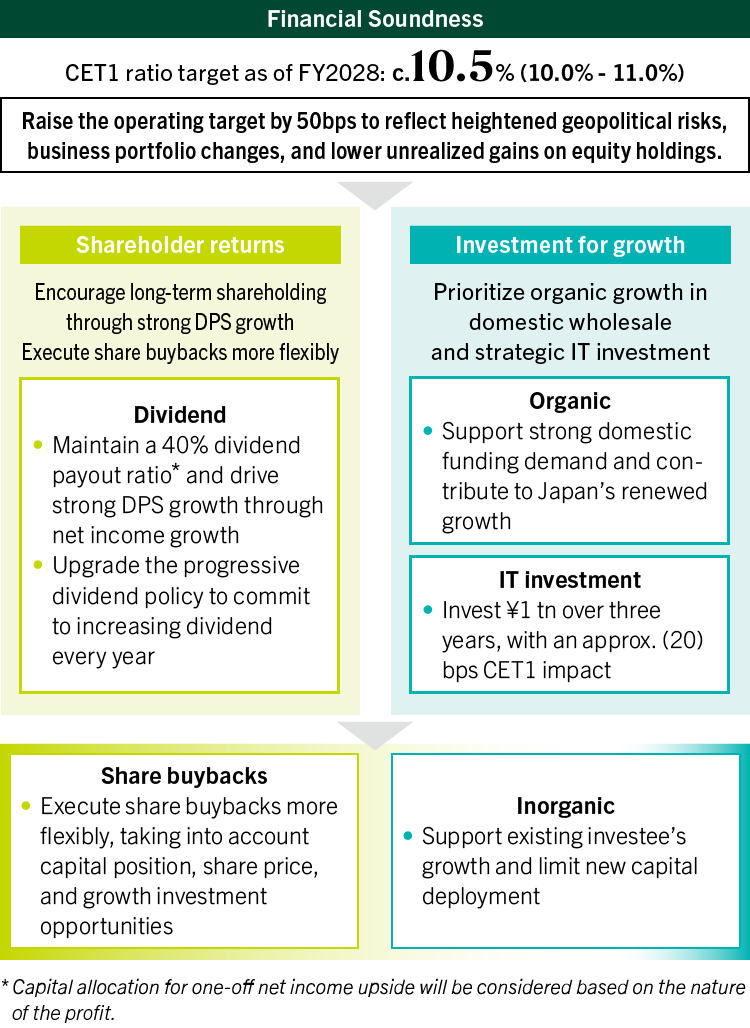
Under the new Medium-Term Management Plan, there is no change to our basic capital policy of balancing stronger shareholder returns and investment for growth while maintaining financial soundness. Taking into account heightened geopolitical risk, changes in our business portfolio, and a reduction in unrealized gains resulting from efforts to reduce equity holdings, our target is to reach a CET1 ratio of 10.5% by the end of the new Medium-Term Management Plan.
Shareholder Returns
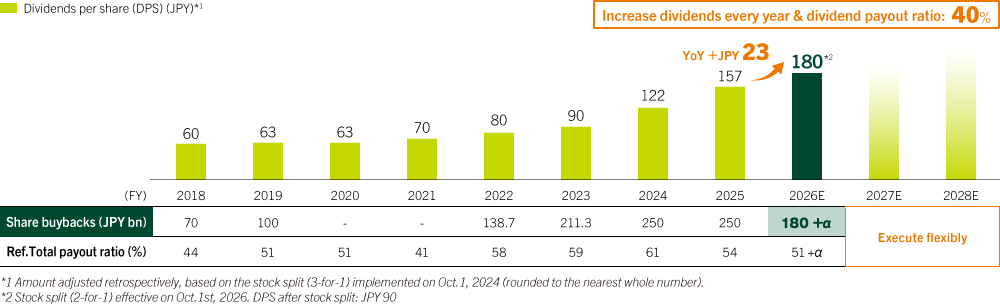
Dividends remain our primary approach to shareholder returns as we seek to make SMBC Group shares more attractive to long-term investors. We will maintain a dividend payout ratio of 40% and increase total dividends through bottom-line profit growth. In addition, under our progressive dividend policy, we will shift from our traditional stance of “not reducing dividends” to a more proactive commitment to “increasing dividends every fiscal year,” thereby enhancing the predictability of future dividend growth. We will also take a more agile approach to share buybacks, taking into account our capital position, investment opportunities for growth, SMBC Group’s share price, and other key factors. Our dividend forecast for FY2026 is ¥180 per share, a year-on-year increase of ¥23. In May 2026, we announced a share buyback program of ¥180 billion and will consider additional buybacks during the year. We also announced a stock split and the introduction of shareholder benefit programs to make our shares more accessible and attractive to hold.
Investment for Growth
For investment for growth, we will allocate the capital we have raised from the disposal of low margin assets to higher margin assets mainly in Japan. In the previous Medium-Term Management Plan, our reduction efforts focused on our overseas businesses. In addition to the reduction of low-return assets in project finance and non-Japanese corporate finance, we disposed of our U.S. railcar leasing business and shut down our U.S. digital bank. Under the new Medium-Term Management Plan, we will reduce low-return assets by ¥9 trillion in both Japan and overseas while capturing opportunities arising from strong domestic corporate funding demand, thereby limiting the increase in organic Risk-Weighted Assets over the three-year period to ¥5.5 trillion.
We have positioned technology as a core management pillar and will allocate capital to IT investments to further accelerate our use of AI and digital technology. While fundamentally enhancing our IT infrastructure and development capabilities, we will use AI to increase productivity and the value we offer customers, in addition to using AI to refine risk management and other aspects of our management infrastructure. On the other hand, for our inorganic investments we will focus on monetizing our current investments.
Reducing Equity Holdings
We announced a plan to reduce equity holdings by ¥600 billion over five years and have already completed a reduction of ¥309 billion over the two-year period through FY2025, putting us well ahead of schedule. At the same time, partly due to rising share prices, it remains challenging to reduce the ratio of the market value of equity holdings to consolidated net assets. We will keep firmly in mind our target of reducing this ratio to below 20% by the end of FY2028 and continue persistent negotiations with clients so that we can achieve the target ahead of schedule.
Increasing Corporate Value
~Further Enhancing ROTE/ROE that is Accompanied by Growth~
In order to increase our corporate value, we will pursue not only stronger earning power but also sustainable profit growth. Leading global financial institutions use ROTE as a key profitability metric, and we have adopted ROTE because it facilitates comparison with global peers. At the same time, we will continue working to improve ROE, a metric commonly referenced by domestic investors. As Group CFO, I will strengthen earning power, exercise appropriate capital control, and reduce risks that concern investors, while also working to improve ROE with a clear awareness of the gap with our peers.
Strengthening Earning Power
The first driver of ROTE and ROE improvement is stronger earning power, which represents the numerator. We will focus on increasing profit from our core businesses and achieving steady, consistent profit growth. In Japan, we will capture opportunities arising from robust corporate activity while also securing deposits in a world that has returned to positive interest rates. In terms of deposit growth, we have successfully differentiated ourselves from peers, with Olive accounts exceeding 7.5 million and an increasing number of these accounts being used as primary accounts. Our rate of deposit growth is higher than that of our peers. Trunk accounts have also surpassed 50,000. By winning highly sticky deposits from corporate clients, we will strengthen our earning power in a positive interest rate environment. Overseas, we will focus management resources on Global CIB, S&T, the Multi-Franchise Strategy, and other key strategic areas as we work to monetize these businesses. Regarding our Multi-Franchise Strategy, we openly acknowledge that returns on investment are currently below expectations. We are undertaking difficult reforms, including major changes to the senior management teams of partner companies and stricter credit standards. We have also established a framework under which employees involved in evaluating investments are also involved in the PMI process. We have positioned the new Plan term as a critical period and will devote our utmost efforts to improving profitability.
Furthermore, growth in asset-light businesses that can increase profit with limited additional capital is critical and we will enhance our wealth management, asset management, and transaction banking.
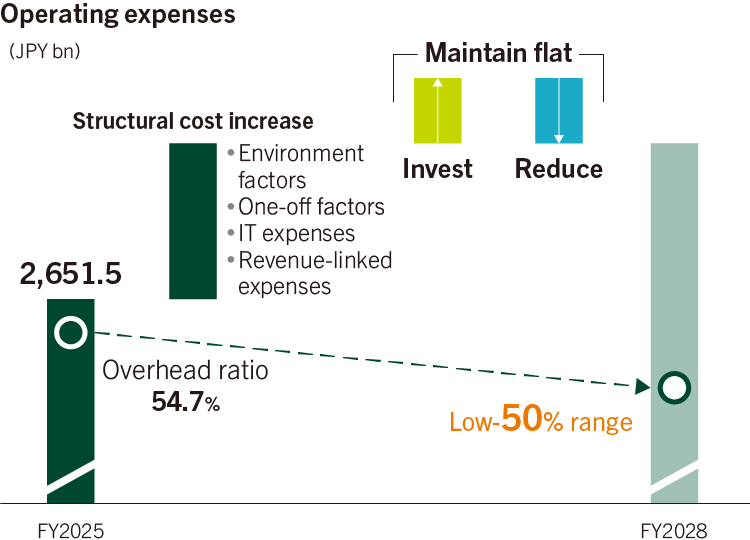
Controlling expenses is also very important. We aim to achieve an overhead ratio in the low-50% range by the end of the new Medium-Term Management Plan. However, rising domestic interest rates and top-line growth may act to lower our overhead ratio, which could in turn weaken expense discipline. We will therefore continue to make the necessary investments for growth, while keeping operating expenses flat or below current levels, excluding increases attributable to environmental factors, such as inflation and foreign exchange, and structural factors, such as IT expenses and revenue-linked expenses. By doing so, we will further strengthen the linkage between revenue growth and net income growth.
Controlling Capital
The second driver to improve ROTE and ROE is the appropriate control of capital as it is the denominator. While securing sufficient equity capital is essential for a financial institution, excessive capital retention leads to a decrease in capital efficiency. With a CET1 ratio of 10.5% as our target, we will maintain a sufficient level of capital by strengthening shareholder returns and reducing equity holdings/low-return assets.
Furthermore, with rising geopolitical risk coupled with robust funding demand in the domestic market, I understand that stable capital management has become a more important metric in which investors evaluate financial institutions. We will continue to control risk assets in a highly disciplined manner.
Such an approach to capital allocation also applies to inorganic investments. We will adopt a highly disciplined decision-making process when future investment opportunities arise by carefully determining the strategic rationale, return on investment, and associated risks. Furthermore, when executing an investment, we will strictly control PMI and other post-investment measures to ensure that we consistently generate profit and corporate value.
I am also fully aware that unrealized gains on our equity holdings in our overseas partner firms are weighing significantly on our financial leverage. We will launch actions to address this issue during the new Medium-Term Management Plan.
In order to increase corporate value, enhancing ROTE and ROE is not enough. We must also control capital costs. We are paying careful attention to the Middle East situation and other geopolitical risks, in addition to inflation resurgence risk. SMBC Group will add forward-looking provisions while also enhancing our risk management capabilities. Going forward, we will continue to thoroughly implement agile risk control in response to changes in the business environment while transforming our business portfolio in a manner that balances stability, profitability, and growth. This will allow us to realize stable profit growth even when risk manifests and control capital cost. From the standpoint of generating sustainable profit and reducing future risk, we will also invest in human capital and create social value.
Communicating with Stakeholders
In FY2025, SMBC Group was selected for the “Award for Excellence in Corporate Disclosure” in the banking category by the Securities Analysts Association of Japan for the second consecutive year. I believe this not only reflects the Association’s recognition of SMBC Group’s disclosure framework, it also reflects their expectations for further improvement. As the uncertain environment continues, SMBC Group will engage in the timely and easy-to-understand disclosure of key topics.
Engaging in constructive discussions with investors and other stakeholders is not only an important mission for me as Group CFO; the discussions are also valuable learning opportunities. The new Medium-Term Management Plan and capital policy reflect the feedback we received through such discussions. Having said this, we must not forget the importance of nimbly adjusting our various goals based on changes in the business environment. I will continue my discussions with our stakeholders to further evolve the new Medium-Term Management Plan and realize the sustainable growth of SMBC Group’s corporate value.