Business Strategy

Towards Our Vision: “Globally connected. Rooted in Japan. Your most trusted partner.”
The Future of SMBC Group as Outlined in the New Medium-Term Management Plan
When formulating its new Medium-Term Management Plan, SMBC Group established its New Vision “Globally connected. Rooted in Japan. Your most trusted partner.” In this roundtable discussion, Outside Directors Jun Sawada, Sonosuke Kadonaga, and Charles D. Lake II, together with Group CFO & CSO Kazuyuki Anchi, all of whom were heavily involved in the formulation process, discuss how the new Medium-Term Management Plan and the ambitious medium- to long-term targets of ROTE of 15% and bottom-line profit in the mid- ¥2 trillion range took shape, as well as the strategic intent behind the plan and their resolve to execute it.
-
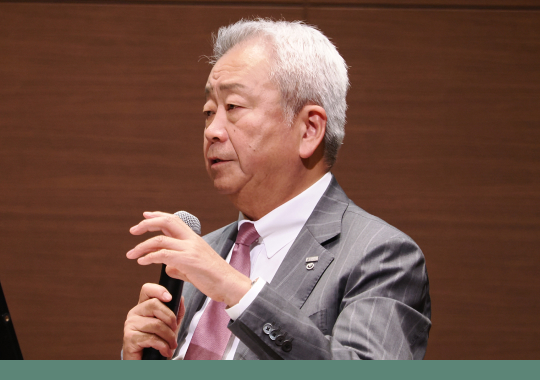
“The key point is to build an approach tailored to each situation, determining how far processes should be adapted from current operations, rather than adopting every kind of cutting-edge technology.”
Jun Sawada Outside Director
-
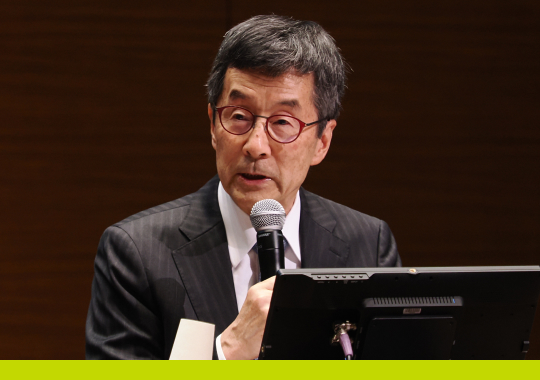
“Management decisions are effectively cascaded down to employees, and I sense SMBC Group excels at translating these decisions into results.”
Sonosuke Kadonaga Outside Director
-
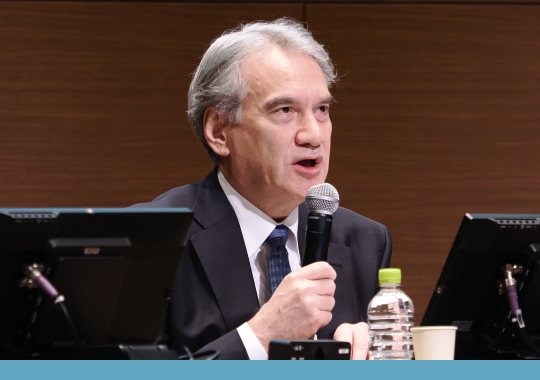
“In a rapidly changing business environment, SMBC Group must evolve its plans and operations in an agile way and respond to change strategically.”
Charles D. Lake II Outside Director
-
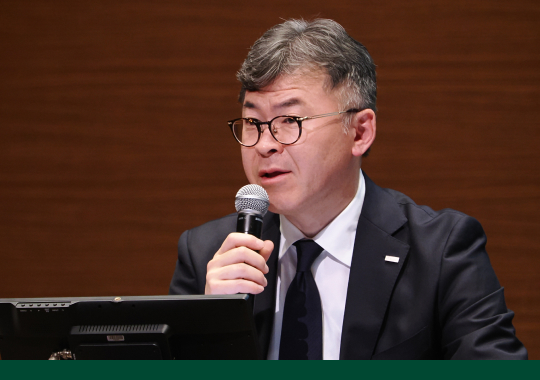
“I take pride in the fact that the new Medium-Term Management Plan was developed after extensive discussions. However, what matters most is effective execution.”
Kazuyuki Anchi Group CFO & CSO,
Director Senior Managing Executive Officer
Formulating the New Medium- to Long-Term Vision
AnchiIn formulating the new Medium-Term Management Plan, we began by establishing a new Vision and medium- to long-term targets. We then followed a process of setting ambitious goals and building up the discussion by backcasting from these targets and goals. How do you view that approach?
KadonagaAround the summer of 2025, I had an opportunity to discuss a draft of the new Medium-Term Management Plan at a Board of Directors meeting. My honest impression at the time was that, while I could understand the overall direction, such as generating revenue from investments made under the Multi-Franchise Strategy and strengthening the securities business, the core pillar of the new Medium-Term Management Plan was not yet entirely clear. In that sense, I felt that the new Medium-Term Management Plan lacked excitement. By excitement, I do not mean simply making the qualitative narrative more appealing. Rather, I mean communicating clearly what kind of company SMBC Group wants to become, in addition to setting ambitious targets. Previous medium-term plans created a certain sense of anticipation, whether by highlighting social value creation or by taking on forward-looking challenges such as the Multi-Franchise Strategy in Asia. In response to this feedback, a backcasting approach was incorporated into the planning process. For example, in IT investment, the new Medium-Term Management Plan now clarifies where gaps exist with global competitors and the targets, timelines, and approaches for closing them. Having been involved in the management of various companies as a management consultant, I believe it is rare for financial institutions to adopt such an approach in strategy planning. I therefore view this very positively.
SawadaEstablishing a new Vision makes a great deal of sense to me. When I was involved in management at NTT, it used the phrase “Your Value Partner.” At the time, the concept of being a partner went beyond a simple business relationship and articulated the aim of creating value together with customers and society. I understand SMBC Group’s phrase “trusted partner” to have a similar meaning. I also sensed this mindset when I took part in discussions with a broad spectrum of employees from various business units. Accordingly, I view this Vision as a declaration of SMBC Group’s commitment to enhance its corporate value as it advances to a new level.
AnchiI recall Mr. Kadonaga commenting that the new Medium-Term Management Plan lacked excitement. One of the biggest challenges in developing the new Medium-Term Management Plan was creating a clear message that would inspire both employees and external stakeholders. People in financial institutions tend to be highly earnest and disciplined, which can sometimes make it difficult to generate a sense of excitement.
Indeed, in the early stages of discussion, we spent much of our time focusing on how to address the issue of low profitability in our overseas business, which naturally led to a rather sober tone. By incorporating the ambition to become the leading financial institution in Japan, highlighting our roots in Japan, and aspiring to reach global standards in technology, we were able to strike a balance between addressing today’s challenges and creating an inspiring Vision for the future. The phrase “trusted partner” also incorporates various commitments. Given the breadth of the services offered by SMBC Group, our relationship is no longer a simple financial institution–customer model. Instead, we are now supporting our customers in a variety of ways, beyond established frameworks. Although some employees seek specific guidance from management, I believe that employees and customers should develop an approach together, rather than management defining it unilaterally.
Enhancing Capital Policy and Shareholder Returns
AnchiIn formulating the new Medium-Term Management Plan, Outside Directors engaged in in-depth discussions on capital policy and shareholder returns. The upgrade of the progressive dividend policy to commit to increasing dividends every year, as well as the stock split and shareholder benefit program, were all ideas that emerged from our discussions with Outside Directors. How would you rate the process that led to the plan’s formulation and the new policies?
LakeI commend SMBC Group for enabling a series of substantive discussions, including at the Board of Directors, on the critical issue of how to deliver on stakeholder, including shareholder, expectations. The Corporate Governance Code calls for companies to achieve sustainable growth, enhance corporate value over the medium to long term, and strengthen their earning capability. Discussions focused on how to strike a balance between predictability and flexibility in capital policy while also emphasizing a balance between financial soundness, investment for growth, and shareholder returns from a stakeholder perspective, even in an uncertain business environment. The new Medium-Term Management Plan enhances predictability by committing to annual dividend increases while maintaining a 40% dividend payout ratio and striving to execute share buybacks more flexibly. The phrase “more flexibly” signifies that SMBC Group will respond in a flexible manner after carefully assessing its capital position, share price, and growth investment opportunities. It is vital to build stronger relationships with the shareholders who support SMBC Group’s long-term growth strategy and maintain long-term shareholdings. In my capacity as an outside director, I also believe SMBC Group should meet the expectations of long-term investors through appropriate supervision of a flexible capital policy while supporting reasonable risk-taking that contributes to an effective growth strategy.
SawadaI view the adoption of shareholder benefit programs, including “V Point” rewards, as embodying the aim of combining the interests of shareholders and customers to increase corporate value over the long term, rather than as a measure that focuses on SMBC Group’s share price. In that sense, I think aiming for a hybrid model in which the interests of shareholders and customers overlap is highly consistent with current trends.
AnchiFor dividends, the new Medium-Term Management Plan aims to enhance predictability and clearly articulate a path to dividend increases. In contrast, with share buybacks we wanted to be more selective to surprise the market, in a positive sense. Going forward we aim to make decisions on both timing and amount with greater flexibility. While it may not appear significantly different at first glance, we will clearly reflect this approach in its execution of shareholder returns so that stakeholders can recognize that it has taken a step further.
Key Priorities for Delivering the New Medium-Term Management Plan
AnchiThe new Medium-Term Management Plan entails a major transformation, and I recognize that achieving its goals will not be straightforward. What aspect do you believe warrants the greatest attention in achieving the targets adopted in the new Medium-Term Management Plan?
KadonagaHaving observed SMBC Group from the outside for around a decade, what has struck me most is its exceptionally strong frontline execution excellence. Management decisions are effectively cascaded down to employees, and I sense SMBC Group excels at translating these decisions into results. However, for inorganic investments, the strategy for post-merger integration plans and resource deployment, including talent, lacked clarity at times. I have long regarded this as an issue and pointed it out to the executive side on several occasions. In the new Medium-Term Management Plan, while it makes sense to focus on generating returns from investments made under the Multi-Franchise Strategy, it is not appropriate to discuss Asian countries as if they were a single market. Conditions differ from country to country, including in terms of market growth phases, the competitive environment, the effectiveness of business models, and regulatory policies. The new Medium-Term Management Plan already reflects these differences, but I believe it will be vital to clarify in external communications that tailored responses for each country are, of course, necessary.
LakeIn the process of formulating the new Medium-Term Management Plan, the Board of Directors engaged in open and constructive discussions, including on past successes and failures. Amid ongoing conditions that make it difficult to anticipate changes in the business environment, including geopolitical risks, I commend SMBC Group for developing the new Medium-Term Management Plan by thoroughly taking into consideration the external and internal environment, as well as SMBC Group’s own strengths and challenges. With that said, unforeseen events will inevitably occur as the New Medium-Term Management Plan is executed. When that happens, the operations side and the Board of Directors must confront and address uncomfortable realities with integrity. I believe SMBC Group should face the changes in the internal and external environment head-on, engage in organic discussions, and enhance the new Medium-Term Management Plan’s effectiveness by continuously refining it with agility, rather than as something that cannot be changed for three years.
AnchiInvestors have often observed that we demonstrate strong discipline in organic investments but have been less disciplined in inorganic investments. While I think we have become more meticulous in identifying issues over the past few years, additional issues that need to be addressed still come to light, so we must step up our efforts in this regard. For example, a common feature across investees in Asia is that deposit acquisition is extremely important for controlling funding costs. However, as both the macro environment and the positioning among financial institutions differ from country to country, approaches and challenges also vary. Recently, the situation in the Middle East has created an additional challenge, as its impact is more likely to be felt in Asia. We will address this challenge appropriately.
The Significance of Creating a Medium-Term Management Plan in an Era of Uncertainty
AnchiThe Board of Directors discussed whether creating a Medium-Term Management Plan in an era of such high uncertainty was a meaningful endeavor. What is your stance on it?
SawadaIn today’s world, geopolitical shifts and technological innovations, exemplified by AI, are unfolding at a rapid pace and with a high degree of uncertainty. Accordingly, I fully understand the argument calling for management to adopt a practical approach of changing strategies flexibly in light of the external environment, similar to the Observe–Orient–Decide–Act (OODA) Loop method, rather than executing strategies based on a Plan–Do–Check–Act (PDCA) cycle. However, that approach alone is not sufficient. SMBC Group must firmly define a clear vision of its future—what it aims to achieve and where its shared value lies—in a Medium-Term Management Plan and act flexibly within that framework. These two elements may seem contradictory. However, I think arguing that a medium-term plan is unnecessary because the environment is changing is a little too simplistic. I hope that SMBC Group will both maintain a strong vision and realize the flexible execution of the new Medium-Term Management Plan.
LakeThere is a saying in strategy research: “plans are worthless, but planning is everything.” In the current era, I believe integrating two types of strategic thinking, waterfall and agile thinking, is imperative. When viewing the new Medium-Term Management Plan using these two types of strategic thinking, the plan has set forth a long-term target of achieving a ROTE of 15% based on SMBC Group’s long-term Vision and established a clear direction to boldly transform the Group’s business portfolio. Achieving this target and Vision requires SMBC Group to drive operational reforms in accordance with waterfall thinking. In that sense, formulating a medium-term plan is necessary for mobilizing the organization. At the same time, in a rapidly changing business environment, SMBC Group must continue to adapt its plans and operations in an agile way and respond strategically to change.
AnchiAnother important point is that employees need to be convinced by our strategies. We formulated the new Medium-Term Management Plan while gathering insights on the observations and aspirations of a broad spectrum of employees, both in Japan and overseas. What makes the biggest difference in execution is how fully employees internalize and act on the strategies. I believe it is crucial for executing strategies effectively to reassess our position and communicate its strategic priorities every three years.
Investment in Leveraging IT and AI
AnchiUnder the new Medium-Term Management Plan, we plan to invest ¥1 trillion in leveraging IT and AI. This decision entailed repeated discussions, including a gap analysis against top-tier global financial institutions. How do you evaluate this investment plan?
KadonagaThe Board has a shared understanding of the key management challenges related to technology. Cloud migration must be accelerated, and establishing AI-enabled development environments can no longer be delayed. Cybersecurity is also likely to remain an area where it is difficult to keep pace, no matter how many measures SMBC Group takes. Although everyone is aware of these urgent issues, they cannot be solved overnight. The Board of Directors also discussed whether raising IT investment to ¥2 trillion would further accelerate the response. However, given constraints such as talent availability, we concluded that ¥1 trillion would be an appropriate level. As I stated earlier, I urged management to identify where gaps exist with global competitors and to clarify timelines and approaches for closing them. Following subsequent discussions, the strategy has become much clearer and easier to understand.
SawadaSpeaking from my own experience serving concurrently as President and Chief Executive Officer of NTT Security, SMBC Group operates its security at a very high level. At the same time, Japan overall trails the rest of the world by several laps in some respects in the IT field. Financial institutions are still in the early stages of cloud migration, and they must also address AI use. The key point is to build an approach tailored to each situation, determining how far processes should be adapted from current operations, rather than adopting every kind of cutting-edge technology.
Although AI produces accurate answers, it will produce accurate but incorrect answers if fed incorrect data. Since everything depends on the quality of the input data, deploying AI with a strong focus on data governance is crucial.
AnchiAn investment in IT of ¥1 trillion today should achieve a different level of efficiency than the same amount of investment would have achieved in the past. We will establish KPIs, including development efficiency metrics, and monitor them closely. In addition, establishing internal governance for advancing digitalization is of critical importance, as only by ensuring such governance will we be able to leverage AI globally. Over time, I think securing robust governance will help SMBC Group gain recognition as a trusted financial institution when working with external parties.
Enhancing Global Governance
LakeLooking back over the past year, I think one of the most valuable topics of discussion has been the enhancement of global governance. Today, overseas revenue accounts for approximately 40% of SMBC Group’s total revenue. Going forward, further advancing SMBC Group’s global governance will be indispensable as it expands its global activities under the Vision, “Globally connected. Rooted in Japan. Your most trusted partner.” and to grow to become a leading global bank. In order to further strengthen the partnership between SMBC Group and Jefferies, as well as quickly adopt global technology changes, such as Frontier AI, into SMBC Group’s strategies, it is important to ensure strategic alignment between the regional or local subsidiary boards and the Sumitomo Mitsui Financial Group Board of Directors. We should further enhance governance initiatives, including the face-to-face dialogue between these boards. I applaud the constructive discussions that took place at the SMFG Board of Directors meetings to ensure such strategic alignment and to advance governance initiatives.
AnchiTo share one specific example, when we announced various partnerships with Jefferies, including the establishment of SMBC Nikko Jefferies Securities, the Board of Directors emphasized the importance of close coordination on a global basis. I therefore personally attended meetings of the boards of directors of local subsidiaries in the United States and Europe six times each. At these meetings, I explained the status of strategies under consideration and our approach and worked to build alignment with local management. As transformations in areas such as global CIB, asset management, transaction banking, and global markets are all efforts that require global mutual understanding, we put in place frameworks to this end based on the observations of the Board of Directors. We remain committed to executing a range of strategies based on a shared global understanding.
Lastly, I take pride in the fact that the new Medium-Term Management Plan was developed after extensive discussions. However, what matters most is effective execution. We will work on the new Medium-Term Management Plan to deliver clear results, including addressing the challenges facing the Multi-Franchise Strategy.
I hope all Outside Directors will continue to pose incisive questions from a wide range of stakeholder perspectives, even when they may at times challenge the management team.
Roundtable Discussion on Risk Management
Building Resilience Through In-Depth Analysis of Uncertainty
Geopolitical risks are intensifying, cyber threats are becoming more advanced with highly sophisticated AI, and Japanese interest rates are rising. Amid this unprecedentedly complex and interconnected risk environment, the SMBC Group is working to achieve a high level of resilience. Charles D. Lake II, an outside director and chair of the Risk Committee, joined Group Chief Risk Officer (CRO) Natsuhiro Samejima and Group Chief Financial Officer (CFO) and Group Chief Strategy Officer (CSO) Kazuyuki Anchi to discuss SMBC Group’s current governance framework and the challenges that lie ahead.
-
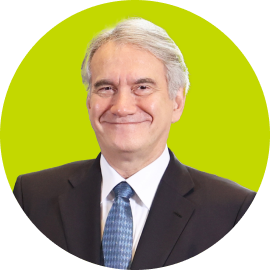
Charles D. Lake II Outside Director
Chair of Risk Committee 
-
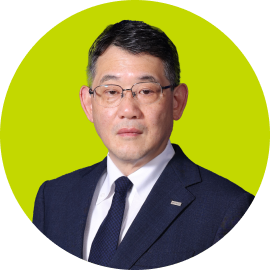
Natsuhiro Samejima Senior Managing Executive Officer
and Group CRO -
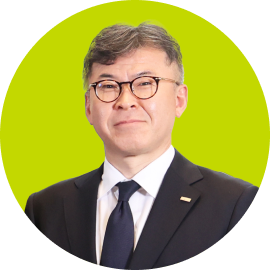
Kazuyuki Anchi Group CFO & Group CSO, Director
Senior Managing Executive Officer
Incorporating Risk into Management Strategy
SamejimaI feel that the nature of the risks we are currently facing is fundamentally different from before. These include the protracted instability in the Middle East, shifts in U.S. tariff policy, credit uncertainty in the private credit market, cyberattacks and technological risks arising from the use of highly sophisticated AI, as well as scenarios in which fading AI expectations lead to AI-related stocks decline. These risks are increasingly likely to materialize in a complex and interconnected way rather than emerging independently. Looking at Japan, the trend toward rising interest rates is intensifying competition for deposits and making balance sheet management more difficult.
AnchiIn formulating our new Medium-Term Management Plan, we spent more time than ever assessing the external environment and identifying risks. In addition, geopolitical risks in the Middle East materialized in the final stages of the process, so the new Medium-Term Management Plan effectively began under conditions of extremely high uncertainty. In that sense as well, it has become more important than ever to discuss how to incorporate risk into management strategy in order to achieve the targets set out in the plan.
LakeTo ensure an effective risk management framework, I see three key points that the Risk Committee should focus on. The first is setting the committee agenda strategically. For the Risk Committee, which is an internal committee of the Board of Directors, to truly contribute to deeper discussions of priority strategic areas at the Board level, it is essential to work closely with the operations side, and that includes working with Mr. Samejima, our Group CRO, to identify issues that are directly linked to management strategy. In 2025, in preparation for the new Medium-Term Management Plan, we focused our discussions on key areas such as recognition of external environmental risks, the Risk Appetite Framework, and basic policies for risk management. By supporting the formulation, execution, and review of the management strategy, these elements can make a meaningful contribution to integrated risk management. The second point is fully drawing on the insights of each committee member, based on their expertise and practical experience. In addition to Outside Director Isao Teshirogi, the Risk Committee includes external experts such as Tatsuo Yamasaki*1 and Hirohide Yamaguchi*2, who bring a wealth of knowledge and experience. It is important that members engage in substantive, real-time discussions about SMBC Group’s risk environment, rather than formal or procedural exchanges. As chair, I make a conscious effort to build on members’ comments by asking further questions, encouraging an active exchange of perspectives that leads to new insights and deeper discussion. The third point is the active participation and engagement of senior management in the Risk Committee. A framework in which management internalizes the Committee’s discussions in real time and ties them directly to agile operations and to the Board’s oversight function enables stronger responsiveness and effectiveness in governance amid rapid change.
*1 Tatsuo Yamasaki (Specially appointed professor at the International University of Health and Welfare, former Vice Minister of Finance for International Affairs)
*2 Hirohide Yamaguchi (Chairman of the Advisory Board of Nikko Research Center, former Deputy Governor of the Bank of Japan)
Transitioning to a More Resilient Business Portfolio
LakeIn executing our management strategy, I believe one of the most important changes in the external environment is the structural shift in the interaction between geopolitics and the economy. Geopolitical risks are shifting significantly, with risks materializing on a much larger scale and at a far faster pace, while their impacts are becoming less predictable. This creates a particularly challenging environment. The Risk Committee has repeatedly emphasized the importance of looking beyond individual risk events to assess the [broader] world order and macroeconomic implications, as well as reviewing risk management as an integrated set along with strategy formulation.
AnchiRather than focusing only on surface-level developments, I have once again come to appreciate the importance of always questioning the underlying core of these changes.
SamejimaWe have made it our highest priority to build resilience—the capacity to keep our business running under any circumstances responding to such environmental changes. Specifically, we identify top risks based on internal and external developments, map out the risk transmission pathways, and prepare countermeasures accordingly. We modeled a scenario where three risks— protracted Middle East conflict, disruptions in private credit markets, and fading AI expectations—materialize in combination and simulated their impact on financial soundness through stress testing. Based on the results, we are reviewing our operating policies and putting in place contingency plans for crisis situations. Another key area of focus is strengthening frontline risk ownership. Frontline teams are expected to detect early signs of a situation that differs from normal conditions and escalate them appropriately. We are also reinforcing a framework in which the first and second Line work closely together to determine which risks to take and which must be avoided.
LakeIn addition, it remains critically important to enhance early warning monitoring and strengthen our response when events occur. To achieve this, it is crucial to make full use of the Risk Committee, where members with deep expertise come together and engage in high-quality, real-time discussions centered on scenarios developed by the operations side. As SMBC Group continues to grow as a key player in the global financial and capital markets, we aim to further strengthen the Risk Committee functions to ensure a highly effective risk management framework that enables SMBC Group to maintain its agile management under a robust governance structure, even in a rapidly changing environment.
AnchiIn such a highly uncertain environment, I believe it is essential to proceed with two pillars: portfolio transformation and strengthened risk management. Risk management alone is not enough; we must fundamentally transform our portfolio into one that is resilient to risk. By steadily promoting these efforts over time, I am confident that we can ultimately demonstrate to our stakeholders both the stability of our performance and our ability to respond to and recover from crises.